

How Tech Will Save Fashion
Fashion tech's overlooked opportunity can help independent brands operate at the same level as publicly traded enterprises

Big Fashion’s Unfair Advantage
Fashion is an industry that thrives on the innovation of small players. In this industry, product innovation comes from new styles which almost always proliferate from the bottom up: independent designers push boundaries in creating experimental styles which gradually get adopted by the mass market.
While design innovation is imperative to pushing the industry forward, it is operational innovation that has propelled fashion to be the $3 trillion industry it is today. Design innovation cannot exist without the commercial viability of the underlying organization to support it, and much of this is achieved through advancements in technology (particularly integrating IT in operations).
Fashion is often compared to restaurants as it is a notoriously difficult business to take profits in. Headlines are perpetually embellished with brand and retailer defaults and labels trading creative directors like athletes every time it financially underperforms. Think of SSENSE filing for bankruptcy protection, Saks’s endless restructuring which ultimately led to a Chapter 11 filing, Y/Project shutting down after 14 years of business, and Versace swapping out a creative director (Dario Vitale) after only one season.
The high fixed costs and complex logistics of these businesses give larger players a natural advantage as they have the resources and scale to optimize operations. Enterprises have teams dedicated to optimizing everything from their material sourcing to production costs down to the cents, and systems in place to capture every website visit and click, then tailor outreach to that specific prospect. Nike alone has a headcount of ~75,000 people (though about 50% are estimated to work in retail), and Lululemon even has a dedicated internal calendar team. Contrast this to smaller brands that may be driving product innovation, but barely have a system of record for keeping track of all their SKUs.
In a business where margins are slim by nature, capturing an extra 0.1% can be the difference between a profit and a loss. Achieving this is nearly impossible for emerging brands, as high overhead and a breadth of operational functions often leave operators fighting to keep things running, making optimization and systematization a secondary priority.
Fashion’s Technorenaissance
2025 showed us that AI can (and will) create real and meaningful returns in businesses. Everything from generative marketing materials to customer support agents proved that our current team structures, day-to-day tasks, and economic realities will be vastly different in the next 5 years. GenAI alone is projected to create $150-$275 billion of operating profit in fashion, according to McKinsey. Enterprises are aware of this, with companies like Nike, Zara, Louis Vuitton, H&M, and more investing ~$1.5 billion in AI adoption projects.
However, not all fashion businesses have dedicated technical talent to do this; in fact, many don’t even have systematized operations to begin with. While we may envision a world where a fashion founder can automate inventory replenishment, use AI to write advertising copy, and have an agent process customer orders and returns, the reality is far from it. Most sub-10-person teams in a mature, non-tech-centric industry like apparel are more focused on keeping afloat with day-to-day operations than investing in high-tech solutions.
Bridging the Gap
I’ve spent the last year building a fashion brand, which is currently one of Toronto’s fastest-growing independent ready-to-wear labels. Out of manufacturer emails and Excel sheets came Inseam, which harbors our mission to achieve the operational efficiency that enterprises are striving for as an SMB. I’m entirely confident that this is possible, as we’ve seen it be done in other industries (particularly software development) and now have access to an unprecedented amount of tools to leverage.
Through speaking to over 50 brand operators across functions like design, production, and merchandising, we’ve realized that despite the amount of tooling that is now accessible, SMBs still struggle to implement technology (specifically software) in their processes.
I hypothesize that this is a two-pronged effect:
Brand Operators
The overlap between highly technical people and operators in apparel (broadly also applicable to CPG and physical products businesses) is limited. IT investments, therefore, require operators to invest already scarce resources into researching and almost always need to be outsourced at an SMB level. 15% of SMBs reported keeping up with fast-changing technology as a top challenge in 2025.
IT does not sit as high on an emerging brand’s list of priorities as it should. Brands are more focused on speed to market and see building scaling systems as more of a cost than an investment in the early stages. With the wide array of organizational functions required to bring a physical product to market, problems are often addressed as they occur rather than systematically prevented. This in turn causes 90% of AI initiatives to fail to scale beyond the pilot phase as organizations have insufficient underlying technology and data to support the programs.
Technologists
Likewise, there is only a slim overlap between technologists who have the skills and knowledge to architect solutions to operational challenges and those who have a deep understanding of the fashion industry. This makes it challenging to create tools that are actually value-generating. The limited collaboration between technologists and operators makes it difficult to establish the fast-paced iteration and feedback loops necessary for a technical product to achieve market fit.
The SMB Opportunity
Part of the challenge with working with SMBs is that they are highly unstructured and often do not have any formalized systems in place. However, this is also the beauty of SMBs, as this creates an opportunity to build new systems from scratch, in a way that is compatible and scalable with where technology is headed.
Last year, Business of Fashion declared that we are in the midst of a fashion tech boom. A quick exercise in tracking headlines and where VC dollars are going will reveal that most of the companies fueling this boom are consumer-facing (B2C virtual try-on, digital closet) or meta-consumer-facing (B2B2C generative marketing assets, online shopping plug-ins). I think the real opportunity is in the back-end operations of these businesses, as systematizing manual processes and unstructured data is where value is generated by multiples rather than percentage points.
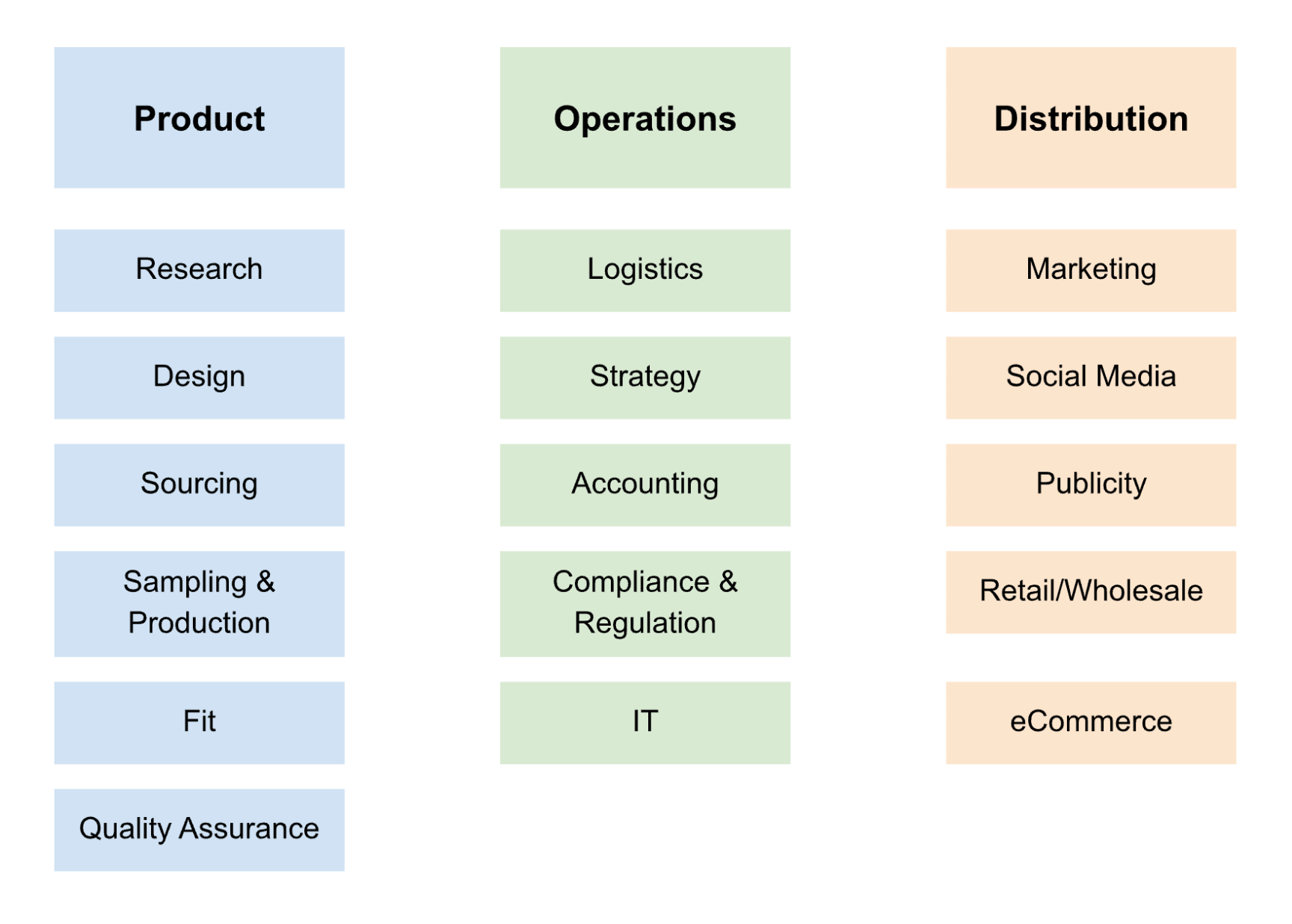
This is because the process of producing and selling a physical product is incredibly complex, with a single product requiring 400+ decision points from design to final mass production (now imagine this scaled across a multi-product collection). Each decision point represents an opportunity for errors which can carry costs that make the difference in profitability. Systematizing these processes early on sets a brand up for scaling and avoids costly migration later on. This also acts as the foundation for embedding automation into repetitive workflows, as any executional function, AI or not, requires some kind of decision trace to follow. This sets us up for a world where teams can multiply output per a fixed headcount and compound the benefits of future technological advancements as they have invested in a compatible infrastructure. By applying technology to the back-end operations, brands make themselves competitive and scalable from the inside.
The Future Is Ours
If apparel SMBs don’t adopt operational innovations, the economic gap with enterprises will continue to widen. Fashion is a mature industry that will benefit hugely from operational innovation due to the relatively lower regulatory barriers (compared to fintech and healthcare), and SMBs have the benefit of developing AI-native systems from scratch. Its creative and executional nature makes it the perfect place for AI to augment manual and scaling processes while freeing up human talent to do more strategic and creative work. SMBs, like startups, are amazing vehicles for quick iterations and high-impact solutions, yet the flywheel has not taken off. To position the industry to fully take advantage of the next 5 years of technological revolution, we need to establish a more collaborative environment between operators and technologists.
Pilots are happening and an increasing number of SMBs are either thinking about embedding technology in the foundation of their operations or actively doing it. 39% of SMBs already have ERPs for some functions and plan to expand across other departments. However, this is still concentrated at larger-scale businesses since these companies have defined departments to begin with. These are companies that are solving for an extra 0.1% margin boost, not the ones that are balancing Excel sheets, Notion pages, and loose PDFs just to remain functional. 2026 is an inflection point for SMBs who have the benefit of a lean and highly iterative structure to leverage technology to its fullest capacity. While fashion tech has boomed over the past year, the biggest opportunity remains overlooked, as it’s in expanding the size of the industry through setting SMBs up for scaling. We now have the potential for a single-founder company to operate at the same level of systems and intelligence as a 75,000-person enterprise, and how fashion embraces tech and vice versa will determine if the potential becomes reality.
About Inseam
Inseam was developed from our experience as brand founders and engineers. We provide brands across fashion and CPG with a centralized operating system that supports scaling while minimizing costs.
We’re currently helping brands automate record keeping, such as tracking SKUs and production, which acts as the foundation for operational visibility and additional AI-integrations.
We are continuously working with a small group of design partners - please feel free to reach out to jess@inseam.ai to get in touch!
It’s chicken and egg problem, you need data to train AI to make decisions, but if you are large enough to actually have that data, implementing AI is too cumbersome… oh well, we will get there. Great article!
its so ironic that its the smaller brands who produce the more innovative and “interesting” garments that push the boundaries of fashion yet are forced to struggle with the margins and all the complications of a physical goods brand. staying afloat in an environment where funding is not thrown around like it is in the tech world is definitely challenging, but ripe for technological disruption.